General cargo ship · China flag · built 2017
DA QING: CO₂ emissions 2019–2025
IMO 9768540 EU ETS7 reporting years
- CO₂ reported 2025
- 7,250 t
- Fuel burned
- 2,315 t
- Time at sea
- 2,689 h
- Emitted at berth
- 3% of total
- Share of year under way
- 31%
- Gross tonnage
- 21,992
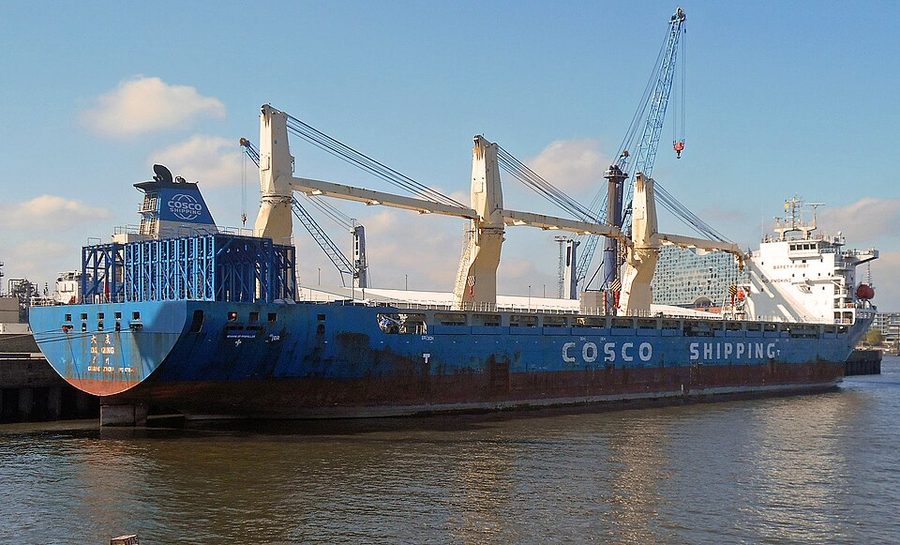

DA QING against its type
Built in 2017, it is 10 years newer than the median general cargo ship on this register, which was built in 2007 (2,852 vessels with a known build year). At 21,992 gross tonnage it is larger than 84% of the other 2,665 general cargo ships with a recorded tonnage. It is one of 38 general cargo ships here under the China flag, 1.2% of the 3,081 on the register. The returns for 2019–2025 all give Guangzhou as port of registry.
Its 7,250 t of CO₂ for 2025 is 2.6 times the median of 2,820 t among the 2,469 general cargo ships on this register that reported for 2025. Per nautical mile it emitted 223.2 kg CO₂, 1.8 times the type median of 122.2 kg. It logged 2,689 hours at sea against a median of 3,044 hours for its type that year. 2.7% of its 2025 emissions were at berth; the median for general cargo ships was 4.3%. Across 5 years with reported emissions, the highest was 2025 (7,250 t) and the lowest 2020 (2,344 t). Its efficiency percentile within the type went from 42 in 2019 to 78 in 2022 (lower is more efficient). Of the 6 comparable vessels listed below with a 2025 return, 2 reported a lower CO₂ per nautical mile than this vessel.
Emissions by year2019–2025
| Year | CO₂ (t) | Fuel (t) | Distance (nm) | At sea (h) | At berth (t) | kg CO₂/nm | EEOI | Percentile |
|---|---|---|---|---|---|---|---|---|
| 2025 | 7,250 | 2,315 | — | 2,689 | 192 | 223.2 | — | — |
| 2024 | 6,342 | 2,026 | — | 2,296 | 368 | 230.6 | — | — |
| 2023 | No EU/EEA voyages reported | |||||||
| 2022 | 3,089 | 980 | 12,596 | 1,046 | 136 | 245.3 | 34.6 | 78 |
| 2021 | No EU/EEA voyages reported | |||||||
| 2020 | 2,344 | 751 | 9,261 | 747 | 262 | 253.1 | 11.9 | 12 |
| 2019 | 2,939 | 941 | 10,349 | 853 | 143 | 284.0 | 25.2 | 42 |
Vessel particulars
- IMO number
- 9768540
- Ship type
- General cargo ship
- Gross tonnage
- 21,992
- Year built
- 2017
- Flag state
- China per EU MRV 2025
- Port of registry
- Guangzhou MRV 2025
- Technical efficiency (design)
- EEDI (6.82 gCO₂/t·nm)
- Verifier
- CHINA CLASSIFICATION SOCIETY, China
- Accreditation
- 0003VV
- Compliance document issued
- 2026-03-30
- Compliance document expires
- 2027-06-30
Efficiency against its own type2022
Position 315 of 406 qualifying general cargo ships by EEOI, at the 78th percentile. The dashed line is the type median, 23.3; this vessel reported 34.6.
EEOI divides emissions by transport work, which for this vessel and year was 89,261,485 tonne-miles over 12,596 nautical miles.
Reported CO₂ by year
Reported CO₂ in 2025 was 146.7% higher than in 2019, for EU/EEA voyages only.
From 2024 to 2025, emissions rose 14.3% and CO₂ per nautical mile fell 3.2%.Distance is missing for at least one of the two years, so activity and efficiency cannot be separated here.
Where the 2025 emissions occurred
Methane, nitrous oxide and EU ETS2025
- Total CO₂ equivalent
- 7,364 t
- Methane (CH₄)
- 0.12 t
- Nitrous oxide (N₂O)
- 0.42 t
- Under EU ETS
- 3,992 t, 55% of total
Sources and how to read this
- Emissions: EU MRV publication (THETIS-MRV), reporting years 2019–2025, published by the European Commission.
- Vessel particulars: Wikidata (CC0) and Wikimedia Commons.
This page draws on 7 MRV reporting years, an efficiency ranking, 3 of 5 vessel particulars and a licensed photograph. Not found in the sources for this vessel: AIS movements in Norwegian waters, a name history, a sanctions listing and US port state inspections.
Empty means unreported, never zero. How EEOI, distance, percentiles and sister ships are handled is explained under reading a vessel page. Something wrong? See corrections.