Vehicle carrier · South Korea flag · built 2014
GLOVIS SUNRISE: CO₂ emissions 2018–2025
IMO 9702405 EU ETS7 reporting years
- CO₂ reported 2025
- 10,090 t
- Fuel burned
- 3,231 t
- Distance
- 31,584 nm
- Time at sea
- 1,946 h
- Emitted at berth
- 2% of total
- Share of year under way
- 22%
- Gross tonnage
- 64,546
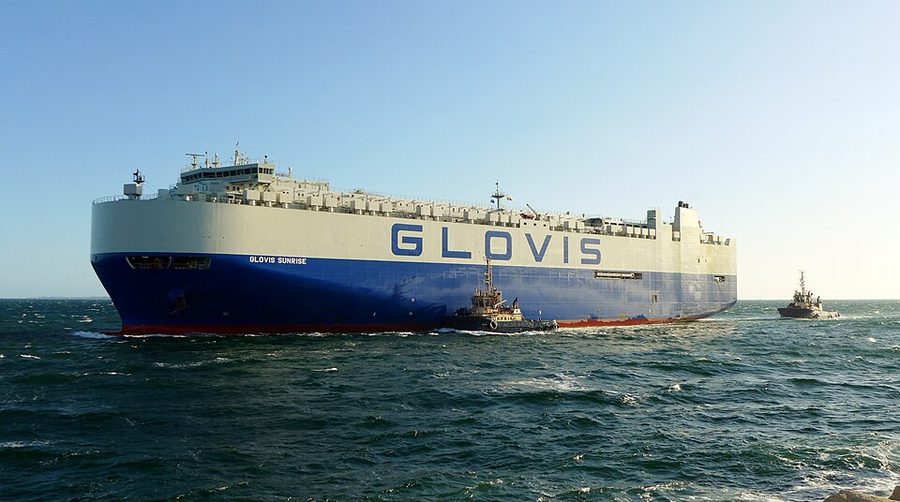

GLOVIS SUNRISE against its type
Built in 2014, it is 6 years newer than the median vehicle carrier on this register, which was built in 2008 (595 vessels with a known build year). At 64,546 gross tonnage it is larger than 78% of the other 571 vehicle carriers with a recorded tonnage. It is one of 43 vehicle carriers here under the South Korea flag, 6.0% of the 713 on the register. The same builder is recorded for 461 other vessels here, 40 of them vehicle carriers. The reported port of registry changed: MAJURO (2018–2021), then JEJU (2022–2025).
Its 10,090 t of CO₂ for 2025 is 43% above the median of 7,074 t among the 514 vehicle carriers on this register that reported for 2025. Per nautical mile it emitted 319.4 kg CO₂, close to the type median of 309.1 kg. It logged 1,946 hours at sea against a median of 1,639 hours for its type that year. 2.0% of its 2025 emissions were at berth; the median for vehicle carriers was 3.1%. Across 7 years with reported emissions, the highest was 2020 (14,487 t) and the lowest 2021 (1,602 t). Its efficiency percentile within the type went from 16 in 2018 to 29 in 2025 (lower is more efficient). Of the 4 sister ships listed below with a 2025 return, 3 reported a lower CO₂ per nautical mile than this vessel.
Emissions by year2018–2025
| Year | CO₂ (t) | Fuel (t) | Distance (nm) | At sea (h) | At berth (t) | kg CO₂/nm | EEOI | Percentile |
|---|---|---|---|---|---|---|---|---|
| 2025 | 10,090 | 3,231 | 31,584 | 1,946 | 199 | 319.4 | 42.5 | 29 |
| 2023 | 12,148 | 3,884 | — | 2,017 | 230 | 374.6 | — | — |
| 2022 | 6,327 | 2,015 | 18,112 | 1,146 | 300 | 349.3 | 41.7 | 15 |
| 2021 | 1,602 | 506 | 3,997 | 275 | 0 | 400.8 | 41.9 | 12 |
| 2020 | 14,487 | 4,598 | 43,308 | 3,016 | 781 | 334.5 | 43.3 | 18 |
| 2019 | 2,770 | 889 | — | 514 | 103 | 386.2 | 88.5 | not ranked |
| 2018 | 5,651 | 1,809 | 15,870 | 1,223 | 243 | 356.1 | 49.5 | 16 |
Vessel particulars
- IMO number
- 9702405
- Ship type
- Vehicle carrier
- Gross tonnage
- 64,546
- Length overall
- 199.0 m
- Year built
- 2014
- Flag state
- South Korea per EU MRV 2025
- Builder
- HD Hyundai Samho
- Port of registry
- JEJU MRV 2025
- Home port
- JEJU
- Technical efficiency (design)
- EEXI (13.9 gCO₂/t·nm)
- Verifier
- Korean Register, Korea, Republic of
- Accreditation
- D-VS-20824-01-00
- Compliance document issued
- 2026-03-31
- Compliance document expires
- 2027-06-30
Efficiency against its own type2025
Position 125 of 423 qualifying vehicle carriers by EEOI, at the 29th percentile. The dashed line is the type median, 51.7; this vessel reported 42.5.
EEOI divides emissions by transport work, which for this vessel and year was 237,623,646 tonne-miles over 31,584 nautical miles.
Reported CO₂ by year
Reported CO₂ in 2025 was 78.6% higher than in 2018, for EU/EEA voyages only. No return is recorded for 2024, so the series has gaps.
From 2023 to 2025, emissions fell 16.9% and CO₂ per nautical mile fell 14.7%.Distance is missing for at least one of the two years, so activity and efficiency cannot be separated here.
Where the 2025 emissions occurred
Methane, nitrous oxide and EU ETS2025
- Total CO₂ equivalent
- 10,248 t
- Methane (CH₄)
- 0.16 t
- Nitrous oxide (N₂O)
- 0.58 t
- Under EU ETS
- 5,380 t, 53% of total
Sources and how to read this
- Emissions: EU MRV publication (THETIS-MRV), reporting years 2018–2025, published by the European Commission.
- Vessel particulars: Wikidata (CC0) and Wikimedia Commons.
This page draws on 7 MRV reporting years, an efficiency ranking, 5 of 5 vessel particulars and a licensed photograph. Not found in the sources for this vessel: AIS movements in Norwegian waters, a name history, a sanctions listing and US port state inspections.
Empty means unreported, never zero. How EEOI, distance, percentiles and sister ships are handled is explained under reading a vessel page. Something wrong? See corrections.