Ro-pax ship · Sweden flag · built 1992
AURORA AF HELSINGBORG: CO₂ emissions 2018–2025
IMO 9007128 EU ETS8 reporting years
- CO₂ reported 2025
- 3,821 t
- Fuel burned
- 1,192 t
- Time at sea
- 4,818 h
- Emitted at berth
- 25% of total
- Share of year under way
- 55%
- Gross tonnage
- 10,918
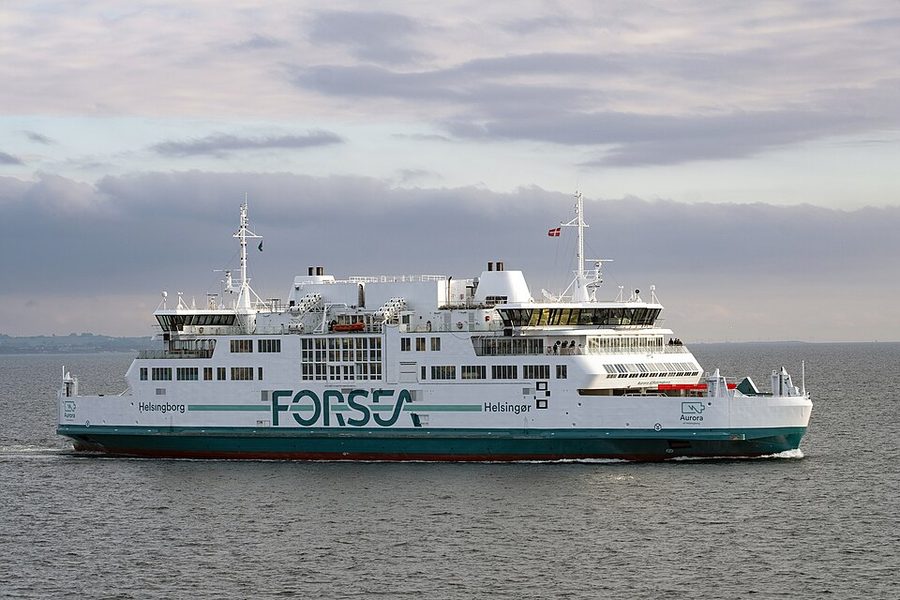
.jpg)
Emissions by year2018–2025
| Year | CO₂ (t) | Fuel (t) | Distance (nm) | At sea (h) | At berth (t) | kg CO₂/nm | EEOI | Percentile |
|---|---|---|---|---|---|---|---|---|
| 2025 | 3,821 | 1,192 | — | 4,818 | 943 | 91.7 | — | — |
| 2024 | 3,109 | 970 | — | 4,805 | 300 | 80.8 | — | — |
| 2023 | 1,907 | 595 | — | 5,103 | 186 | 46.6 | — | — |
| 2022 | 1,419 | 443 | — | 5,033 | 130 | 35.2 | — | — |
| 2021 | 903 | 282 | — | 5,184 | 95 | 21.8 | — | — |
| 2020 | 8,098 | 2,526 | — | 4,988 | 898 | 202.7 | — | — |
| 2019 | 4,176 | 1,302 | — | 5,008 | 183 | 98.9 | — | — |
| 2018 | 10,609 | 3,309 | — | 4,621 | 0 | 272.2 | — | — |
Vessel particulars
- IMO number
- 9007128
- Ship type
- Ro-pax ship
- Gross tonnage
- 10,918
- Length overall
- 110.0 m
- Year built
- 1992
- Flag state
- Sweden
- Builder
- Tangen Verft
- Port of registry
- Helsingborg
- Home port
- Helsingborg
- Ice class
- IB
- Technical efficiency (design)
- EEDI (36.92 gCO₂/t·nm)
- Verifier
- NORMEC VERIFAVIA SAS, France
- Accreditation
- 3-2127
- Compliance document issued
- 2026-03-19
- Compliance document expires
- 2027-06-30
Reported CO₂ by year
Between 2018 and 2025 reported CO₂ fell by 64.0%.
From 2024 to 2025, emissions rose 22.9% and CO₂ per nautical mile rose 13.5%.Distance was not reported for both years, so activity and efficiency cannot be separated here.
Where the 2025 emissions occurred
Methane, nitrous oxide and EU ETS2025
- Total CO₂ equivalent
- 3,880 t
- Methane (CH₄)
- 0.06 t
- Nitrous oxide (N₂O)
- 0.21 t
- Under EU ETS
- 3,821 t, 100% of total
Verifier history
| From reporting year | Verifier | Accredited in |
|---|---|---|
| 2018 | VERIFAVIA (UK) LTD | United Kingdom |
| 2020 | NORMEC VERIFAVIA SAS | France |
A change of accredited verifier is shown because it matters for audit and data continuity. It is not in itself a sign of anything being wrong.
Sources and how to read this
- Emissions: EU MRV publication (THETIS-MRV), reporting years 2018–2025, published by the European Commission.
- Vessel particulars: Wikidata (CC0) and Wikimedia Commons.
What this page is built on
- Reporting years
- 8
- Ranked by efficiency
- no
- Vessel particulars
- 5 of 5
- Movement data
- not observed
- Name history
- none recorded
- Photograph
- yes
- Sanctions record
- none
- Inspection record
- none in US waters
Caveats that apply to every vessel page
EEOI above 100,000 is withheld. Those values come from returns where reported transport work is near zero, which makes the ratio meaningless rather than extreme. Median across the dataset is around 12.
Emission categories overlap. In the MRV return, emissions at berth are also counted inside the voyage legs, so the categories do not sum to the total. They are shown side by side rather than stacked for that reason.
Distance is derived, intensity is reported. The MRV return publishes CO₂ per nautical mile but not the distance itself, which is null in all 106,564 rows of the source. The distance column is therefore filled from the ranking step, which reconstructs it, and is blank for years where a vessel was not ranked. That is why a row can show an intensity without a distance.
Percentile is within type and year. It is the vessel's position among qualifying ships of the same type that year, where lower is more efficient. A blank means the vessel did not qualify for ranking that year.
Sister ships share a builder, a type and a build year within two years of this vessel. That holds hull and machinery roughly constant and leaves operation as the variable, which is why they are listed before nearest-by-tonnage.
Methane and nitrous oxide start in 2024. They were not reported before that period, so earlier years cannot be compared against them.
Technical efficiency is a design figure fixed at construction. A vessel can hold a good index and still emit heavily by sailing fast, waiting at anchor or carrying little.
Inspection records cover United States waters only. An empty record is not evidence of a clean history elsewhere.
Empty means unreported, never zero. Nothing here is modelled, estimated or interpolated. See the methodology.
Something wrong on this page? See corrections. We do not hold the source registers and cannot amend them, but we will fix anything we have got wrong in reproducing them.